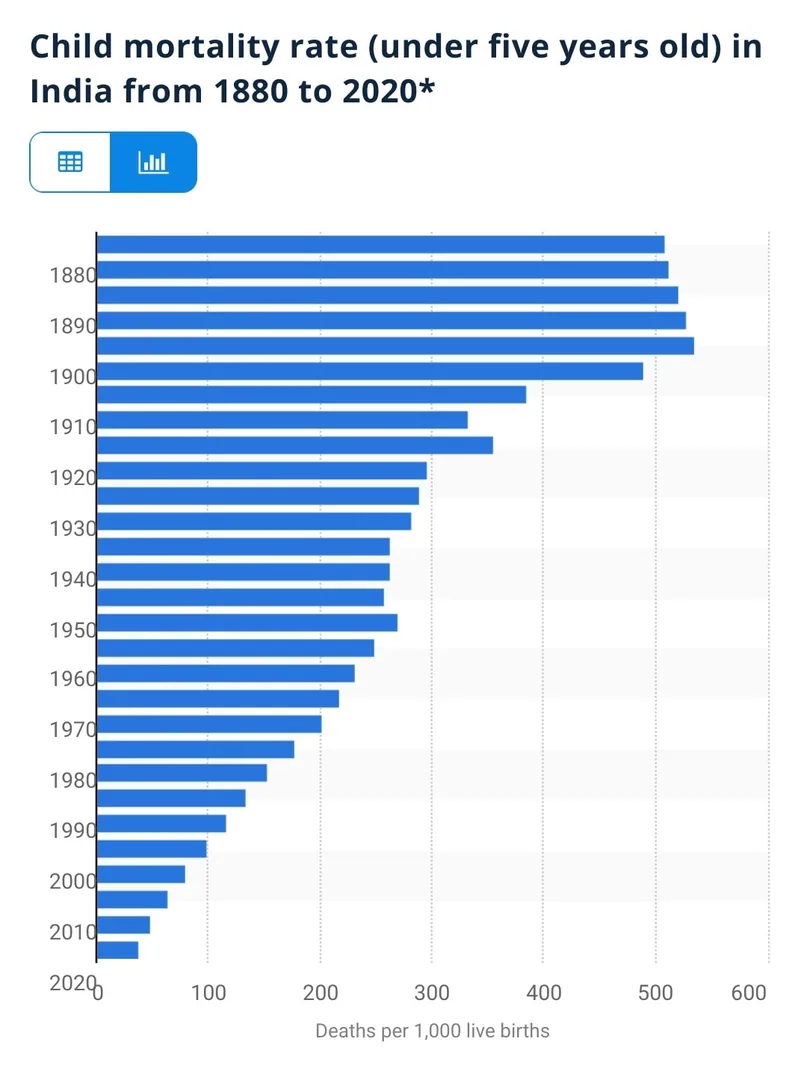
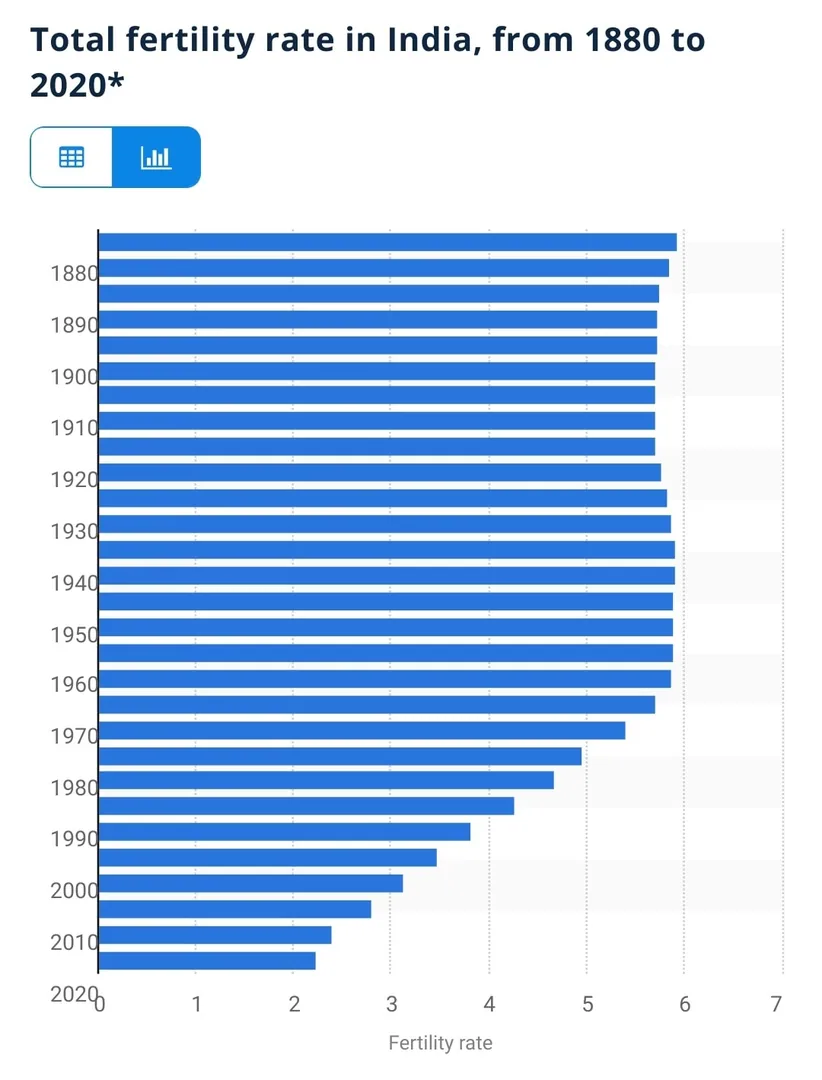
We halved our infant mortality rate in the first half of the twentieth century. But people didn't give a damn and kept making babies. Six babies per women at the time of independence, and two-thirds of them were surviving to the age of five.
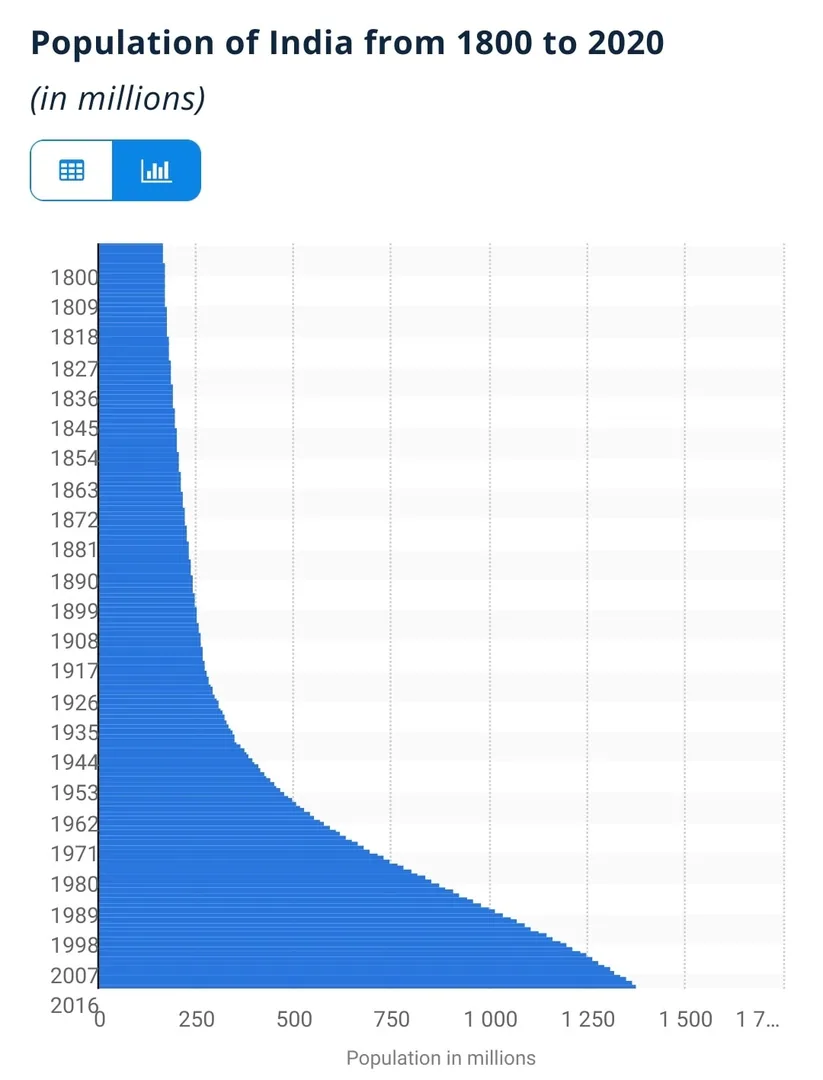
Around the time infant mortality falls below one-third (1920-ish), is when India's population growth hits the hockey stick curve. It goes from being a slow linear to being exponential. (We are back to linear now, except the slope is much higher.)
A common adage is that poor Indians make more babies because they want more hands to work. I think they just want more than one adult child.
In 1900 each woman had six children. Three of them died by the age of 5. And one more died by the age of adulthood. Which is why we were growing really slowly.
By the time of independence, women still had six babies, five of whom celebrated their fifth birthdays. Four survived to adulthood.
It took us twenty more years to realise we are making too many babies. And then the fertility rate starts falling off 1970 onwards.
That 20 year lag corresponds to one generation of children surviving to the age when they reproduce themselves. So they look at their parents and say "Hmm, mom had three kids, all three of us survived. So I just need to have two."
Here's why I went looking for this data. I had an unsettling thought. A lot of people born in the 1930-1960 era weren't expected to survive. Their parents didn't "plan" to have four adult children when they gave birth to six. They were part of a statistical gamble when life was precarious.
We keep hearing about how families chose to send one child to school or college, while the other kids went to work. I wonder if any kids were told to their faces, "we weren't expecting you to survive". You were a statistical anomaly.
That must have really hurt.
Around the time infant mortality falls below one-third (1920-ish), is when India's population growth hits the hockey stick curve. It goes from being a slow linear to being exponential. (We are back to linear now, except the slope is much higher.)
A common adage is that poor Indians make more babies because they want more hands to work. I think they just want more than one adult child.
In 1900 each woman had six children. Three of them died by the age of 5. And one more died by the age of adulthood. Which is why we were growing really slowly.
By the time of independence, women still had six babies, five of whom celebrated their fifth birthdays. Four survived to adulthood.
It took us twenty more years to realise we are making too many babies. And then the fertility rate starts falling off 1970 onwards.
That 20 year lag corresponds to one generation of children surviving to the age when they reproduce themselves. So they look at their parents and say "Hmm, mom had three kids, all three of us survived. So I just need to have two."
Here's why I went looking for this data. I had an unsettling thought. A lot of people born in the 1930-1960 era weren't expected to survive. Their parents didn't "plan" to have four adult children when they gave birth to six. They were part of a statistical gamble when life was precarious.
We keep hearing about how families chose to send one child to school or college, while the other kids went to work. I wonder if any kids were told to their faces, "we weren't expecting you to survive". You were a statistical anomaly.
That must have really hurt.